Religious symbolism is the use of symbols, including archetypes, acts, artwork, events, or natural phenomena, by a organized religion. Religions view religious texts, rituals, and works of art as symbols of compelling ideas or ideals. Symbols help create a resonant mythos expressing the moral values of the society or the teachings of the religion, foster solidarity among adherents and bring adherents closer to their object of worship.
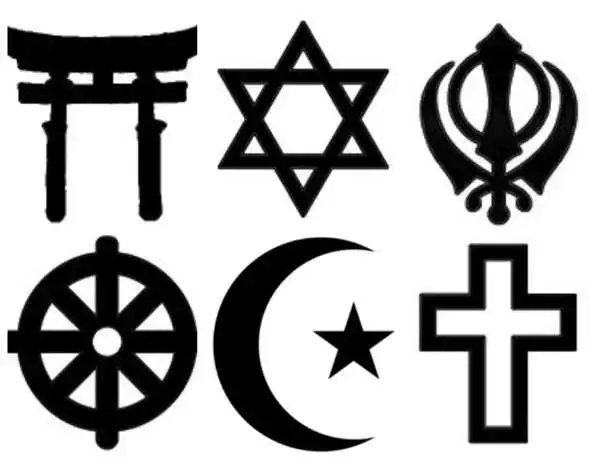
Religious Symbols and their meanings

The study of religious symbolism is either universalist, equally a component of comparative religion and mythology, or in localized telescopic, within the confines of a organized religion's limits and boundaries.

Here are some of the most popular religious symbols from our past.

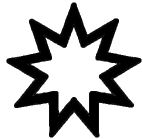
bahai-symbol.jpg (5235 bytes)

Bahai Symbol

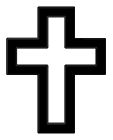
christianity-cross.jpg (3071 bytes)

Christianity Cross Symbol

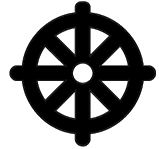
buddhism-symbol.jpg (5646 bytes)

Buddhism Symbol

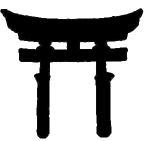
shinto-symbol.jpg (3806 bytes)

Shinto Symbol

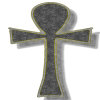
ankh1.jpg (2961 bytes)

Egyptian Ankh Religious Symbol

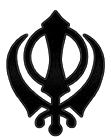
sikhism-symbol.jpg (4770 bytes)

Sikhism  Symbol


Related Religious Jewelry

By the Artist – David Weiztman and Ka Gold Jewelry

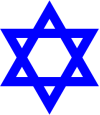
starofdavid100.png (1549 bytes)

Jewish Religious Symbol

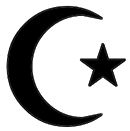
islam-symbol.jpg (3581 bytes)

Islamic Religious Symbol

upright-pentacle.jpg (1742 bytes)

Upright Pentacle-Upright pentacles and pentagrams are among the nearly widely used religious symbols. They accept been used in many eras and by many cultures and religions of the earth: by aboriginal Pagans, ancient Israelites, Christians, magicians, Wiccans and others.

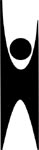
happyman symbol The Happy Human

The Happy Man is a secular icon and the official symbol of the International Humanist and Upstanding Union (IHEU), a earth body for Humanism, and has been adopted by many Humanist organizations and individuals worldwide. Its origin was a competition organized in 1965 past the British Humanist Association to discover a symbol for itself. Denis Barrington created the winning design.

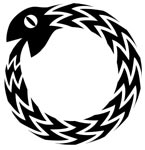
ouroboros symbolThe Ouroboros

often represents self-reflexivity or cyclicality, especially in the sense of something constantly re-creating itself, the eternal render, and other things perceived as cycles that begin anew as presently as they stop.

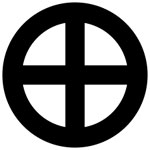
sun crossSun Cross

The sunday cross, or more commonly known as the sun bicycle, a cantankerous within a circumvolve, is a common symbol in artifacts of Prehistoric Europe, particularly during the Neolithic to Statuary Age periods.

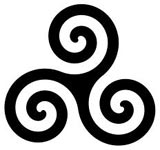
triskelionTriskelion

A triskelion or triskele is a motif consisting of three interlocked spirals, or iii bent human legs, or any like symbol with three protrusions and threefold rotational symmetry. A triskelion is the symbol of Brittany, equally well every bit the Isle of Man and Sicily (where it is called Trinacria).

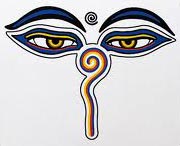
buddha eyesBuddha Optics

On virtually every stupa (Buddhist shrine) in Nepal, in that location are giant pairs of eyes staring out from the four sides of the main tower.These are Buddha Optics (otherwise known as Wisdom Eyes), and they look out in the four directions to symbolize the omniscience (omniscient) of a Buddha.

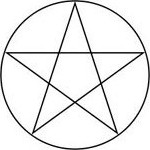
pentagramPentagram

Hither is an image of an upside-down pentagram, the pentagram also appears with the star correct side upwardly. A pentagram is the shape of a five-pointed star drawn with 5 directly strokes. Pentagrams were used symbolically in ancient Greece and Babylonia, and are used today as a symbol of faith past many Wiccans, akin to the employ of the cross by Christians and the Star of David by Jews. The pentagram has magical associations, and many people who practice Neopagan faiths wearable jewelry incorporating the symbol. Christians once more commonly used the pentagram to represent the five wounds of Jesus. The pentagram has associations with Freemasonry and is also utilized past some other conventionalities systems.

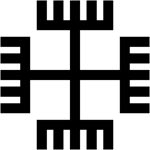
hands of godHands of God

A symbol popularly used as representing Slavic Neopaganism, or more specifically the panentheism advocated past the RPK, is known as "Hands of God."

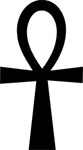
The Ankh

ankh egyptian symbol
Frequently appears in Egyptian tomb paintings and other art, often at the fingertips of a god or goddess in images that correspond the deities of the afterlife conferring the gift of life on the expressionless person'due south mummy; this is thought to symbolize the deed of conception. Additionally, an ankh was often carried by Egyptians as an amulet, either alone, or in connection with two other hieroglyphs that mean "strength" and "health". Mirrors of beaten metallic were also ofttimes made in the shape of an ankh, either for decorative reasons or to symbolize a perceived view into another world.

The ankh was well-nigh never fatigued in silver; as a lord's day-symbol, the Egyptians about invariably crafted important examples of it (for tombs or other purposes) from the metal they most associated with the sun, gold. A similar metal such as copper, burnished to a loftier sheen, was also sometimes used.

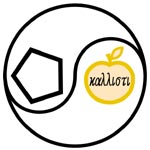
sacred chaoSacred Chao

The Sacred Chao is a symbol used by Discordians to illustrate the interrelatedness of lodge and disorder. The Sacred Chao symbolizes absolutely everything anyone demand ever know about admittedly annihilation, and more! Information technology fifty-fifty symbolizes everything not worth knowing, depicted past the empty space surrounding the Hodge-Podge.

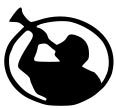
moroniAngel Moroni

The image of the affections Moroni blowing a trumpet is unremarkably used equally an unofficial symbol of The Church of Jesus Christ of Latter-24-hour interval Saints. Moroni appears on the cover of some editions of the Book of Mormon, and statues of the angel stand atop many LDS temples, nigh statues facing eastward.

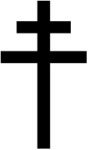
patriarchal crossPatriarchal Cross

The symbol, oft referred to every bit the patriarchal cross, appeared in the Byzantine Empire in large numbers in the 9th century. In the Byzantine Empire of the ninth century, the double cross was not a religious, only a political symbol used by Byzantine clerks and missionaries. Ane of the mod interpretations of the double cantankerous is that information technology represents Slovakia as an heir and guardian of Christian tradition, brought to the region by St. Cyril and St. Methodius, 2 missionaries from the Byzantine Empire.

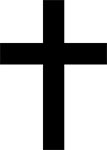
the christian crossThe Christian cross

seen as a representation of the instrument of the crucifixion of Jesus Christ, is the all-time-known religious symbol of Christianity. Information technology is related to the crucifix (a cantankerous that includes a usually three-dimensional representation of Jesus' trunk) and to the more general family of cross symbols.

The cantankerous-shaped sign, represented in its simplest grade by a crossing of two lines at right angles, greatly antedates, in both E and West, the introduction of Christianity. It goes dorsum to a very remote menstruation of human civilization. It is supposed to have been used not just for its ornamental value, but too with religious significance.
The Christian Cantankerous comes in many different forms.

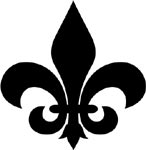
fleur de lysFleur de Lys

While the fleur-de-lis has appeared on endless European coats of arms and flags over the centuries, it is particularly associated with the French monarchy in a historical context, and continues to announced in the arms of the King of Spain and the Chiliad Duke of Grand duchy of luxembourg, members of the Business firm of Bourbon. It remains an indelible symbol of France that appears on French stamp stamps, although it has never been adopted officially by any of the French republics. Co-ordinate to French historian Georges Duby, the three leaves represent the medieval social classes: those who worked, those who fought and those who prayed.

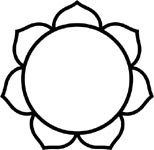
lotus flowerLotus Flower

From ancient times the lotus has been a divine symbol in Asian traditions representing the virtues of sexual purity and not-attachment.

Hindus revere it with the divinities Vishnu and Lakshmi frequently portrayed on a pink lotus in iconography. In the representation of Vishnu as Padmanabha, a lotus issues from his navel with Brahma on information technology.

Goddess Sarasvati is portrayed on a white-colored lotus. Often used as an instance of divine dazzler, Vishnu is frequently described as the Lotus-Eyed One. Its unfolding petals propose the expansion of the soul.

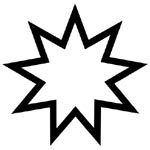
nine pointed starNine Pointed Star

The most commonly used symbol continued to the number 9 is the nine-pointed star; at that place is no particular design of the ix-pointed star that is used more than often than others.

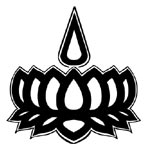
lotus carrying namamLotus Carrying Namam

The symbol of the Ayyavazhi is a lotus carrying a flame-shaped white 'Namam'. The lotus represents the 1,008-petalled Sahasrara and the Namam represents the Aanma Jyothi or atman, sometimes translated equally "soul" or "self".

the winged heartThe Winged Heart or Tughra Inayati

The symbol of Universal Sufism is the Tughra Inayati or the "Winged Heart".The winged centre is an old Sufi symbol, and was chosen by Inayat Khan as the seal of the 'Sufi Order of the Due west' at its founding in 1910. The original rendering of this winged heart calligraphy was presented to Vilayat Inayat Khan on the occasion of his 73rd altogether.

The shape of the tughra symbolises that the heart desires heaven. The crescent in the heart suggests the responsiveness and potential of the heart.

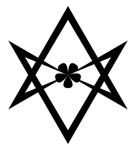
unicursal hexagramUnicursal Hexagram

The unicursal hexagram is a hexagram or half-dozen-pointed star that can exist traced or drawn unicursally, in one continuous line rather than by two overlaid triangles. The hexagram can likewise be depicted inside a circle with the points touching it. It is used in the Greek and Hindu mythologies as a symbol of dedication to the divine rulers.

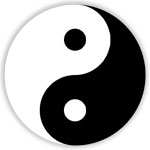
ying yangYing Yang Symbol

In Chinese philosophy, the concept of yin yang, normally referred to in the West as (yin and yang) is used to draw how polar or seemingly opposite forces are interconnected and interdependent in the natural world, and how they give rise to each other in turn. Opposites thus only exist in relation to each other. The concept lies at the origins of many branches of classical Chinese science and philosophy, besides as being a primary guideline of traditional Chinese medicine, and a primal principle of different forms of Chinese martial arts and exercise, such every bit baguazhang, taijiquan (tai chi), and qigong (Chi Kung) and of I Ching divination. Many natural dualities – due east.g., dark and calorie-free, female and male person, low and loftier, cold and hot – are thought of as manifestations of yin and yang (respectively).

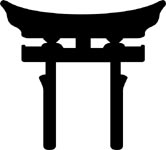
torii symbolTorii Symbol

A torii is a traditional Japanese gate most unremarkably plant at the archway of or inside a Shinto shrine, where it symbolically marks the transition from the profane to the sacred.

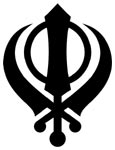
khanda symbolKhanda Symbol

In the symbol the sword to the left represents truth, and the sword to the right represents the willingness to fight for what is right- dharma (faith). The circle in the middle means that there is only one God, never beginning and never ending.The Khanda represents cognition of God, the Chakkar represents the eternal nature of God and oneness of humanity, the two swords stand for Miri (political sovereignty) and Piri (spiritual sovereignty).

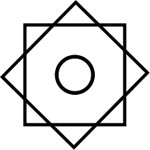
Rub el HizbRub el Hizb

An eight-pointed star was used every bit a symbol of Tartessos, an ancient civilization based in Andalusia. Every bit the region was ruled by Islamic dynasties for eight centuries, this may advise a possible origin of the Rub el Hizb. The symbol is used as a marker for the end of a chapter in Arabic calligraphy.

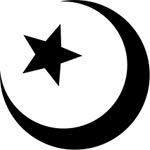
star and crescentStar and Crescent

The star and crescent appear in combination in finds from in and around ancient Israel. It has been associated with the Moabites (14th or early 13th – 6th century BC), as the symbol or symbols announced on what are thought to exist Moabite name seals. During the 19th century, it represented the Ottoman Empire, figuring on the Ottoman flag from 1793. The Ottoman flag of 1844 continues to be in utilize as the flag of the Republic of Turkey.

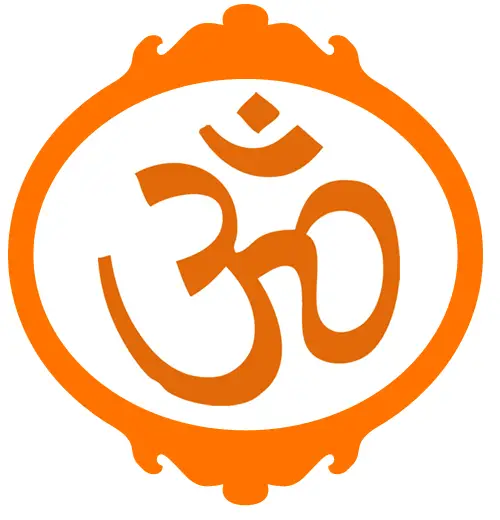
Om AumAum or Om

Aum (Om) is the most sacred of Hindu symbols that is considered representative of both the manifest and hidden aspects of the omnipresent, all-seeing and omnipotent God. It is symbolic of several meaning triads – the 3 worlds (earth, sky and atmosphere); the iii holy Vedic scriptures (Yajur, Sama and Rig); the iii primary Hindu Gods (Brahma, Vishnu and Mahesh or Shiva). Om is also considered to be the virtually sacred of sounds that is the root from which the universe and unabridged being arose and that holds everything together. It is a mystical mantra that is chanted at the outset and terminate of all Hindu prayers, meditations and rituals.

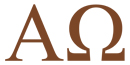
Alpha and OmegaBlastoff and Omega

The combination of ii Greek letters, Alpha and Omega, makes a powerful Christian symbol that represents the eternal existence of God. Alpha is the beginning letter of the Greek alphabet, while omega is the terminal one. Therefore, together they symbolize that God is the starting time likewise as the end. The use of Alpha and Omega symbol of eternity has been traced to early on Christianity and the symbol has been constitute in the ancient Roman catacombs.
The Alpha and Omega are sometimes combined with other Christian symbols such every bit the Cross and Chi-rho.